
We insulate walls, ceilings and floors against neighbours, corridors, lifts and street noise, and we say in advance what result is realistic in your flat rather than after the money is spent.
Where the sound actually comes from
Often not through the wall. Sockets set back-to-back with the neighbour’s, the junction between wall and ceiling slab, gaps around pipe penetrations, a shared ventilation duct, and impact noise travelling through the floor slab are all common paths. Insulating the wrong surface is money spent with no change, so we look for the path first and tell you what we find.
What actually works
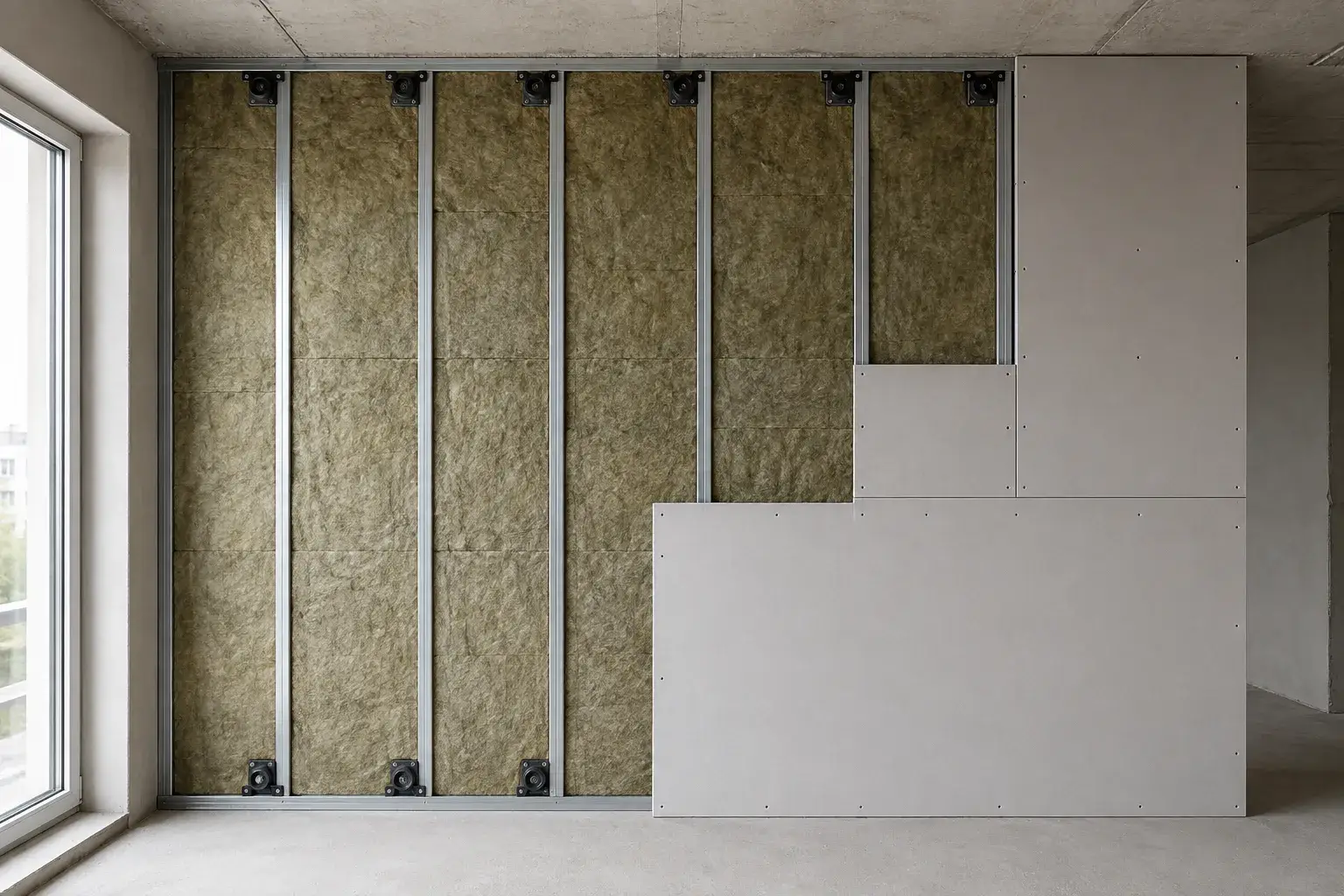
A decoupled frame on vibration mounts, not fixed rigidly to the wall; mineral wool filling the cavity; two layers of board with staggered joints; and a sealed perimeter, because a gap of a few millimetres undoes a large part of the effect. Thin rolled materials advertised as sound insulation give almost nothing on their own — the result comes from mass and decoupling, not from a few millimetres of foam.
Impact noise
Footsteps from above are a different problem from voices through a wall, and they are solved from the floor rather than the ceiling. A floating floor on a resilient layer is the effective answer; a ceiling build-up helps less and costs room height. We say which of the two your case is before proposing work.
What it costs in space
Usually five to ten centimetres per insulated surface, and we show the exact figure on a plan before you decide — in a small room that is a real trade-off and worth thinking about rather than discovering afterwards.
Timing, price and warranty
A wall takes two to four days, a ceiling longer, a floating floor depends on the area and the drying time of the screed above it. Priced per square metre with the build-up specified line by line. Warranty: two years.