
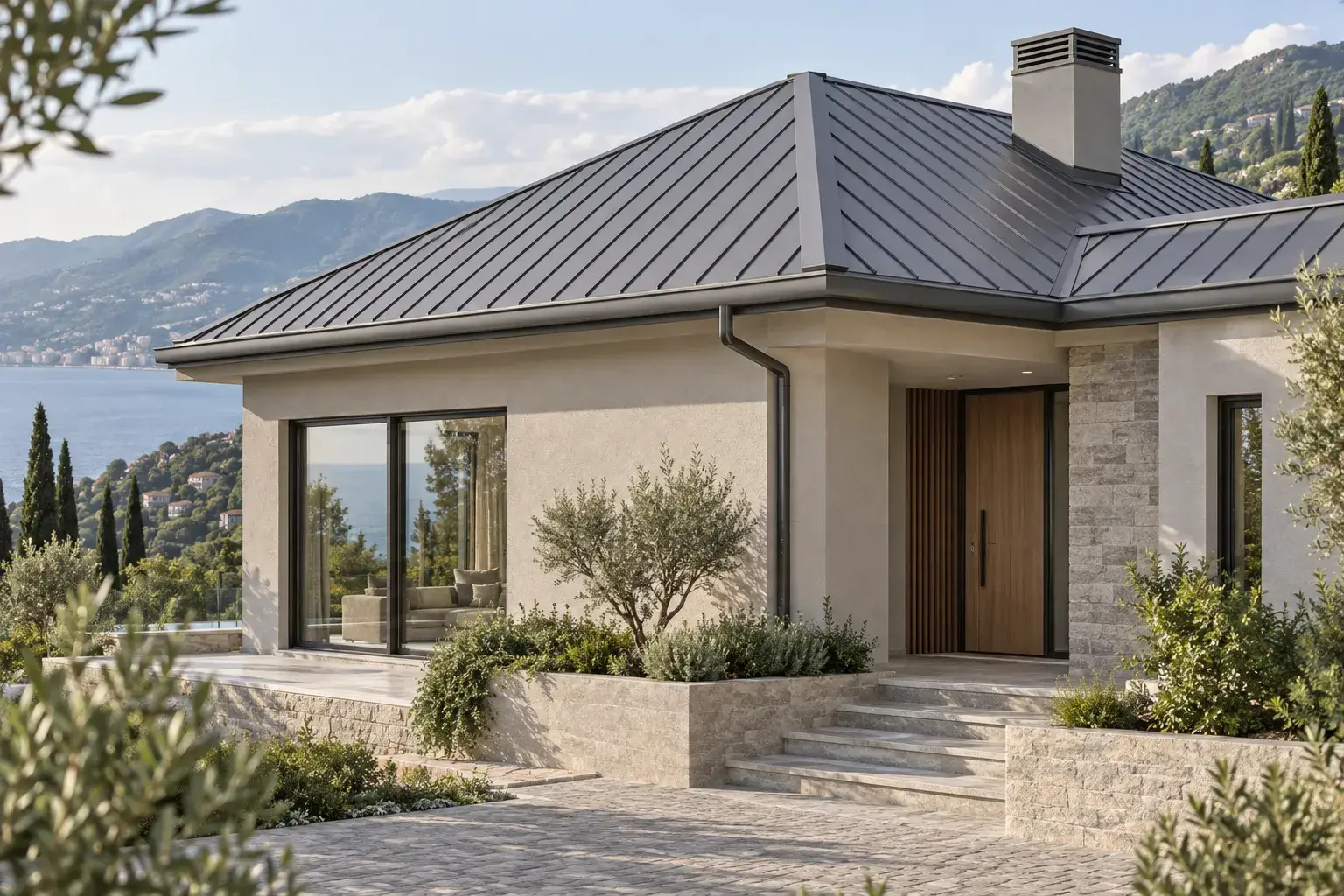
We install and replace roofs, gutters and facade systems, and repair the junctions where most leaks actually start.
What this climate demands
Drainage sized for local downpours rather than average norms — standard gutter sizing overflows here in a heavy autumn rain, and the water then runs down the facade and into the plinth. Roof fixings calculated for wind load, because a storm arrives horizontally and lifts from below. A breathable facade system on a non-corroding subframe: ordinary galvanised subframes near the sea corrode at the fixing points within a few years, and by then the cladding has to come off to reach them.
Leaks come from junctions
Not from the roof covering but from abutments, valleys, penetrations, the parapet and the chimney flashing. On a survey we go through these specifically and photograph what we find. In most cases repairing them costs a fraction of replacing the whole roof, which is what owners are usually offered first — we give both numbers and let you choose with the evidence in front of you.
Ventilation above the ceiling
A roof build-up without a ventilation gap collects condensation in this humidity, and the first sign is a stain that looks exactly like a leak. We check the gap, the intake at the eaves and the outlet at the ridge, because a roof that cannot breathe rots from the inside regardless of how good the covering is.
Facade materials
We specify for salt, damp and UV rather than for a catalogue photograph: coatings with biocide protection where vegetation is close, fixings that do not bleed rust down the wall, and a system that can be repaired in sections rather than as a whole.
Timing, price and warranty
A roof on a private house takes two to four weeks depending on complexity, a facade longer. Works are planned between rains and we say honestly when a start date is unrealistic. We quote a range by phone and give an itemised estimate after the survey. Warranty: five years on the structure, two on finishes.