
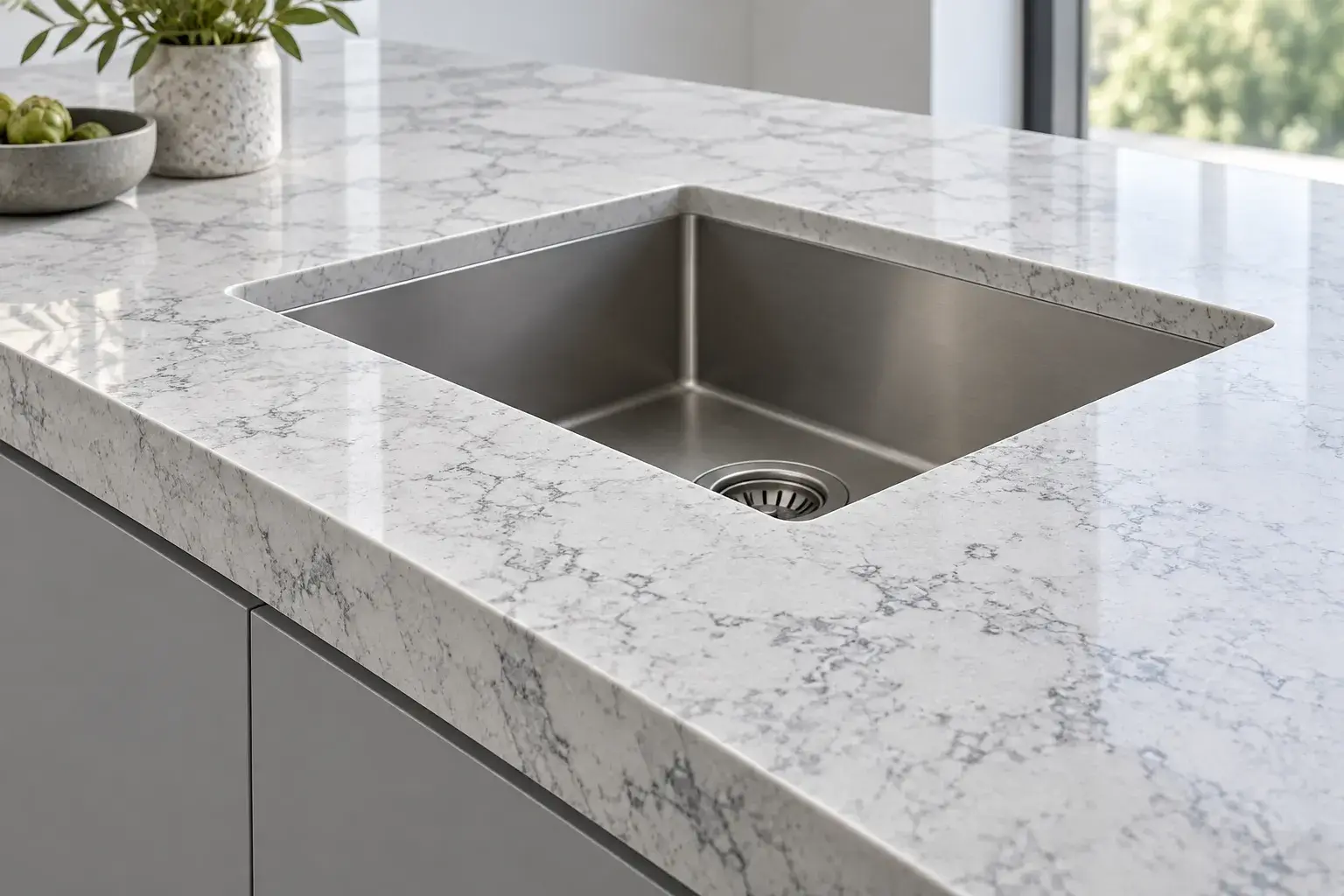
We make and fit worktops in quartz agglomerate and natural stone for kitchens, bathrooms, bars, window sills and table tops.
Quartz or natural stone
Quartz is denser and less porous, which in a kitchen means it resists stains from wine, coffee, citrus and oil without sealing. Natural stone — marble, granite, travertine — has a pattern that cannot be reproduced, but it needs impregnation, and a marble worktop next to a coffee machine will acquire a history. We explain the difference in maintenance before you choose rather than after the first mark appears.
What is decided before cutting
Where the joints fall and how the pattern matches across them; the edge profile, which changes both the look and how comfortable the edge is to lean on; the sink cut-out and whether the sink sits under, over or flush; the tap and filter positions; and the overhang for a breakfast bar, which has a structural limit before it needs support.
Templating on site
Templating happens after the carcasses are installed, never from the drawing, because walls are rarely straight and a worktop cut to a plan leaves a visible gap at the back. On a long run a joint is unavoidable, so we place it where it is least noticeable — not in the middle of the working area and not across the sink.
Care and repair
Quartz needs no sealing and tolerates everyday use, but not a hot pan straight from the hob. Natural stone needs periodic impregnation, which we can do as part of upkeep. Chips at the edge can usually be repaired in place rather than replacing the slab, and we say which cases can and cannot.
Timing, price and warranty
Templating after carcass installation, production one to two weeks, fitting in a day. Warranty: two years.