
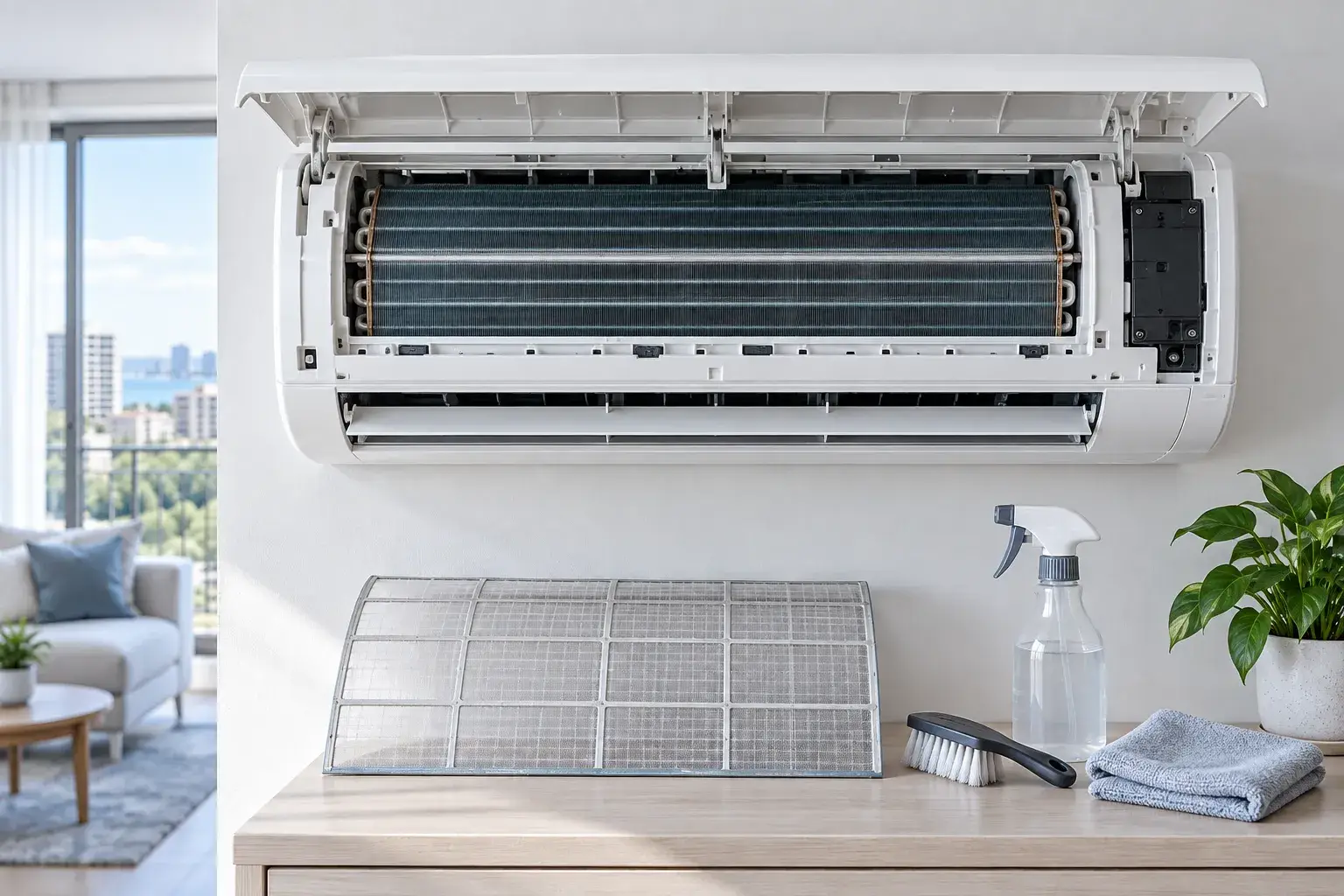
We service split and multi-split systems: cleaning filters and the heat exchanger, checking refrigerant pressure, clearing and disinfecting the condensate line and drip tray, and checking the outdoor unit, its mounting and the electrical connection.
Why before the season
Units fail in the first hot week, when every service company in the city is booked for days. A check in April costs a fraction of an emergency call in July, and if a part is needed there is time to order it rather than waiting with a guest in the flat. For rental properties this is the difference between a service item and a cancelled booking.
Condensate and smell
Water dripping under an indoor unit almost always means a blocked or wrongly laid condensate line, not a broken unit. A musty smell when it starts up means bacteria on the heat exchanger and in the drip tray, and it is removed by cleaning and disinfection rather than by an air freshener that masks it for a week.
On the coast
Salt shortens the life of outdoor units significantly. We wash the heat exchanger, check the casing and the mounting bolts for corrosion, and look at how the unit is positioned — a shaded outdoor unit with free airflow and some protection from spray lasts noticeably longer here than one bolted to a south wall facing the sea.
Refrigerant
A system that cools poorly is not automatically low on refrigerant. We measure rather than topping up by default, because a leak that is refilled instead of repaired empties again by next summer and the gas is not free.
Price and frequency
Once a year before the season for a home, twice for rental properties where the unit runs constantly. Priced per unit, with the outdoor unit included.