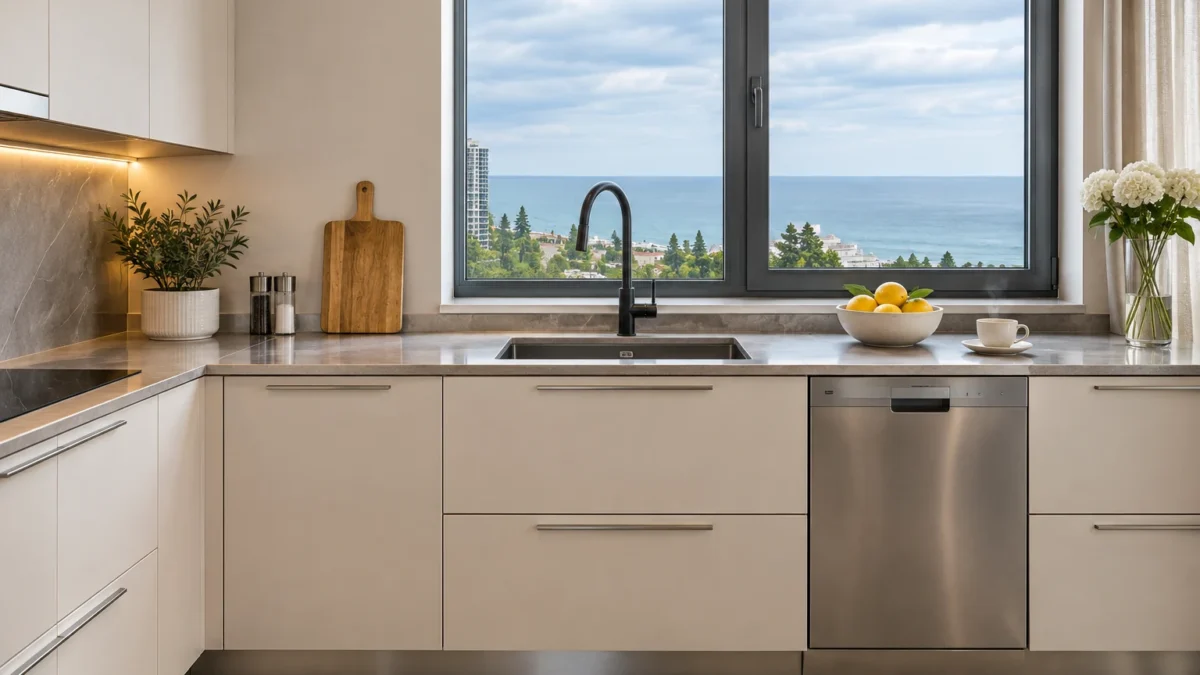
A kitchen in a flat by the sea has a harder life than one in a dry city. Steam from the hob and dishwasher, water at the sink, humid air from the balcony for half the year. Within a couple of years a cheap kitchen swells along the bottom edges, the foil peels off the doors and the worktop by the sink rises in a wave. This is not necessarily a defect: the materials were simply chosen for a different climate. Here is what to build a made-to-measure kitchen from in Batumi, where saving is justified and what to check in the design before the furniture goes into production.
In short
- Carcasses fail through exposed ends and edges. A moisture-resistant board and the right edging matter more than a pretty door.
- The most vulnerable spots: the sink cabinet, the cabinet above the dishwasher, the plinth and the worktop joint at the sink.
- Foil-wrapped doors last the shortest in a hot, humid kitchen. Lacquer, laminate and veneer cope with the climate better.
- A quartz or compact laminate worktop barely notices water. A laminated one needs careful joints and sealant.
- Hardware decides how long the kitchen lasts in a flat that is let, where drawers are opened thousands of times.
What the climate does to a kitchen
Furniture board is made of wood particles or fibres bonded with resin. While its faces and ends are sealed, almost no moisture gets in. As soon as an end is exposed somewhere, be it a raw cut-out for a pipe, a hinge hole or edging that has come away, the board starts absorbing water from the air and from the surface. Swollen board never goes back.
In Batumi humid air works all the time and across the whole kitchen. A flat that stands closed in winter gets several months of damp with no airing. In summer the sun heats the kitchen through a panoramic window, and the foil on the doors suffers from the temperature swings. So materials here are chosen above all for service life.
Carcass: board and edging
Carcasses are most often made from melamine-faced chipboard. It is a perfectly good material if you choose a moisture-resistant grade, usually easy to spot by the greenish colour of the cut. For the sink cabinet and the plinth this is almost a must. MDF is denser and holds fixings better, but its ends also need protecting.
Edging matters more than it seems. It is glued to the ends of the board, and the quality of the glue decides whether it comes off in a year. Polyurethane glue holds up against moisture and heat noticeably better than ordinary hot-melt, so for a kitchen by the sea it is worth asking the manufacturer about it specifically. All holes for pipes and sockets in the back panels are closed with sealant or caps. It is a five-minute job that is often skipped.
An assembled carcass should not stand directly on the floor. Adjustable legs lift it above any puddle, and the plinth covers them.
Doors
Everyone sees the doors, so that is usually where the attention goes. From the climate’s point of view, the options look like this.
- Foil-wrapped MDF doors are affordable and come in any colour. But next to the hob, oven and dishwasher the foil can eventually lift from heat and steam.
- Lacquered MDF gives an even colour and copes well with moisture if it is coated on all sides, including the back. Chips show, but they can be touched up.
- Laminate (HPL or acrylic) on board resists water and scratches and suits kitchens used by many people.
- Natural veneer and solid wood are beautiful and warm to the touch, but need a quality lacquer and care. Next to the sink and dishwasher they have the hardest time.
For a family kitchen, lacquer and laminate work well. For a flat that is let, laminate or a good matt lacquer is more practical, as fingerprints show less on matt shades.
Worktop
The worktop takes water, grease, hot pans and knives. Laminated chipboard is still the most affordable option and serves honestly for years if the joints at the sink and hob are sealed and the cut-outs treated. Its weak point is water: if it gets into a joint or an untreated cut-out, the worktop will swell.
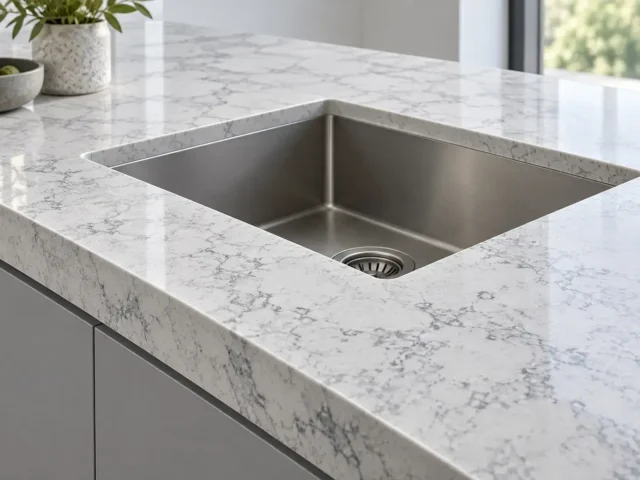
Compact laminate about a centimetre thick does not mind water at all and looks modern. Quartz is strong, does not absorb water or stains and copes with heat within reason. Natural granite is also tough, while marble is beautiful but soaks up wine, coffee and lemon, and in a working kitchen in a flat that is let it is a risky choice. Acrylic solid surface is good because its joints are almost invisible and the sink can be made in one piece with the worktop.
For stone worktops we take measurements from the installed cabinets, so the joints and cut-outs land exactly. More about the materials on the worktops page.
Worktops compared
| Material | Water and steam | Heat and scratches | Where it fits |
|---|---|---|---|
| Laminated chipboard | Fears water at joints and cut-outs | Heat leaves marks, scratches show | Budget kitchen with careful sealing |
| HPL compact | Does not mind | Resists scratches well, heat with a trivet | Flats that are let, modern interiors |
| Quartz | Does not absorb | Strong, heat within reason | Main working kitchen, families |
| Acrylic solid surface | Does not absorb, joints almost invisible | Scratches can be sanded out, fears heat | Complex shapes, integrated sink |
| Granite | Barely absorbs when sealed | Very strong | Heavily used kitchens |
| Marble | Absorbs stains, needs sealing | Fears acids and scratches | A home for yourself, if you accept the patina |
Sink, dishwasher, plinth
The sink cabinet suffers first. A dripping trap or a leaking tap hose can soak the base for weeks before anyone notices. The fix is simple: an aluminium or plastic protective tray on the cabinet base and, if the flat often stands empty, a leak sensor. Pipes are better routed through neat holes with caps, without extra cut-outs in the back panel.
A steam barrier strip or tape is fixed under the worktop above the dishwasher. Without it, steam hits the lower edge of the worktop every time the door opens. Around built-in appliances the ventilation gaps given by the manufacturer are left, otherwise heat and moisture build up in the recess.
A chipboard plinth at floor level swells from mopping and the odd puddle. A plastic or aluminium plinth with a seal costs little and settles the question for good.
Hardware
Hinges, drawer runners and lift mechanisms work every day. Good soft-close hardware lasts tens of thousands of cycles, while cheap hardware starts sagging and creaking within a year or two. By the sea there is one more factor: metal. Hinges and runners with a quality anti-corrosion coating last longer, and stainless steel or aluminium handles do not get rust spots.
Drawers in base units are more convenient than hinged doors: you see everything inside and do not have to reach into the far corner. For corners there are pull-out systems that use the space usually lost in a corner cabinet.
A kitchen in a flat that is let
Guests treat a kitchen differently from an owner. They put hot pans on the worktop, slam doors, leave water in the sink. Here it is better to choose materials that forgive carelessness: laminate or lacquered doors, compact laminate or quartz, soft-close hardware, handles rather than push-to-open systems. Calm, easily repeated colours are the better choice, so that a few years later one door can be replaced without changing the whole kitchen.
How to get a whole flat ready for guests we covered in the article on preparing a flat for nightly letting, and if the flat needs furnishing from scratch, that is part of furnishing a flat for letting.
Common mistakes
- Saving on the carcass and spending on the doors. A couple of years later beautiful doors hang on swollen cabinets.
- Fitting a sink cabinet without a tray and without sealing the cut-outs.
- Ordering the kitchen before the walls, floor and water outlets are ready. Measuring against rough walls almost always leads to gaps and fitting on site.
- Choosing gloss foil for a kitchen with a window on the sunny side.
- Leaving no ventilation gaps around built-in appliances.
Questions and answers
How long does a made-to-measure kitchen take?
From measuring to installation, usually several weeks. Stone worktops are made after the cabinets are fitted, so extra time is allowed for them. The exact timing depends on the materials: some doors and hardware are ordered in.
When should the kitchen be measured during a renovation?
When the walls are levelled, the water and electrical outlets are in place and the floor is finished or its height is known. Then the kitchen will fit exactly, with no gaps at the walls.
MDF or chipboard for a kitchen right by the sea?
Moisture-resistant chipboard with good edging suits the carcass, and lacquered or laminated MDF is better for the doors. Even more important is that every end and hole is sealed.
Can I replace just the worktop?
Yes, if the cabinets are sound. A new stone or compact laminate worktop often refreshes a kitchen more than new doors do.
If you are planning a kitchen in Batumi or elsewhere in Adjara, start with measuring and a design. The made-to-measure kitchens page shows the options we build, and wardrobes and furniture for other rooms are in the custom furniture section. We build bathroom furniture by the same rules: bathroom furniture.