A terrace without a roof in Batumi lives half the year. In summer it is hot under the sun, in autumn and winter slanting rain off the sea floods it. So sooner or later the owner of a private house, villa or townhouse faces the question of a canopy: over the terrace, over the car, over the entrance. Then the arguments start. Steel or aluminium, polycarbonate or louvres, fixed to the house or standing on its own posts. Here is how to choose for your own task and the local climate. A picture in a catalogue is a poor guide here.
In short
- Start with the task: parking, terrace, entrance or almost a room. The span, the roofing and the budget depend on it.
- By the sea, salt and humidity are the main enemies of metal. Steel without hot-dip galvanising and proper paint starts rusting at the welds fairly quickly.
- Steel wins on long spans and under snow in the mountains. Aluminium is more convenient right by the water and wherever you do not want to bother with upkeep.
- In a rainy climate the slope, the drainage and the noise matter: under thin metal and multiwall polycarbonate a downpour sounds like a drum.
- A glazed canopy is already closer to an extension and has to be designed differently.
The task first, then the material
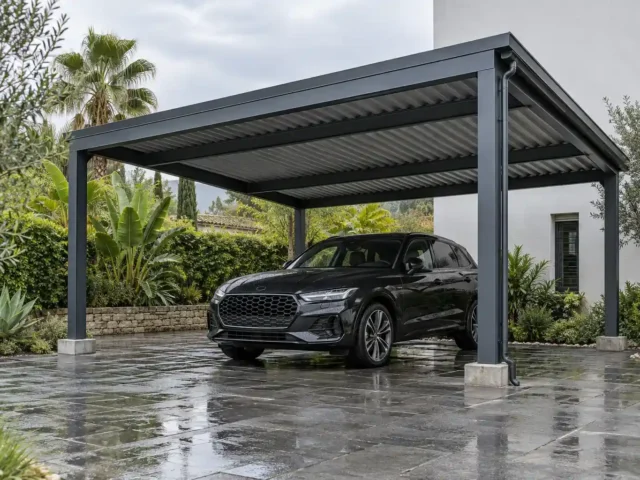
A canopy over one car and a pergola over the dining area on a terrace differ in almost everything. A carport needs a long span, as few posts as possible for easy parking and a roof that can take a falling branch. A terrace asks for something else: lightness, shade in the heat, quiet in the rain and a view of the garden or the sea. A canopy over the entrance is small but hangs on the facade, and there the fixing decides everything.
Try answering a few questions for yourself before talking to a contractor. How many metres need covering without intermediate supports? What will be under the canopy in summer and in winter? Do you need shade or, on the contrary, light? How far is the house from the sea? Will you look after the structure yourself, or does the house stand empty for half the year? The answers almost choose the material for you.
What the sea does to metal
In Batumi, Gonio, Kvariati, Kobuleti and other places along the coast there is always salt in the air. It settles on metal, forms an electrolyte together with moisture and starts corrosion wherever the coating is damaged or thin. The first to give in are welds, bolt holes, the bottoms of posts where water stands and places the rain cannot reach to wash the salt off.
Plain steel painted over rust in a single coat is visible from afar by the sea: orange streaks down the posts after a couple of seasons. Steel that lasts is protected differently. Finished parts are hot-dip galvanised by dipping them in molten zinc, and powder coating goes on top of that. Cold galvanising with zinc-rich paint is better than nothing but does not compare with hot-dip.
Aluminium does not rust in the usual sense: it forms its own oxide film. But by the sea, without protection, it too gets covered in whitish spots, especially cheap alloys. A good profile comes anodised or powder coated. Fasteners have their own subtleties. Ordinary galvanised screws are the first to rust by the sea and leave streaks on a light-coloured profile. You need stainless steel, and for the coastal zone grade A4 is better than A2. One more detail: steel and aluminium in direct contact in a damp environment form a galvanic couple, and the aluminium starts to break down. Joints where they meet are separated with gaskets.
When steel is better
Steel is stronger, and that settles it when you need a long span with no supports in the middle. A canopy over two cars, a wide canopy over a barbecue area, structures that will carry snow in winter. Box section or an I-beam spans distances for which an aluminium profile would need a bigger section or extra posts.
Steel is easier to weld and adjust on site. It is chosen for canopies with heavy roofing: sandwich panels, tiles, heavy-gauge profiled sheet. And steel usually works out cheaper in material, provided the corrosion protection is specified properly. Do not save on the protection itself, or the difference will go on repainting a few years later. The options we build are shown on the pages about steel canopies and steel gazebos.
When aluminium is better
Aluminium is about three times lighter for the same volume, so it is easy to hang on a facade and loads the house less. It does not fear salt the way steel does and needs no regular repainting. For a house right by the water, for apartments and villas that stand empty in winter, it is often the most relaxed option.
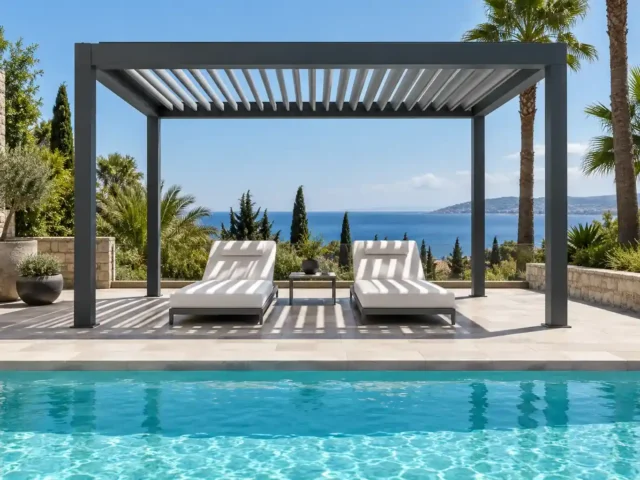
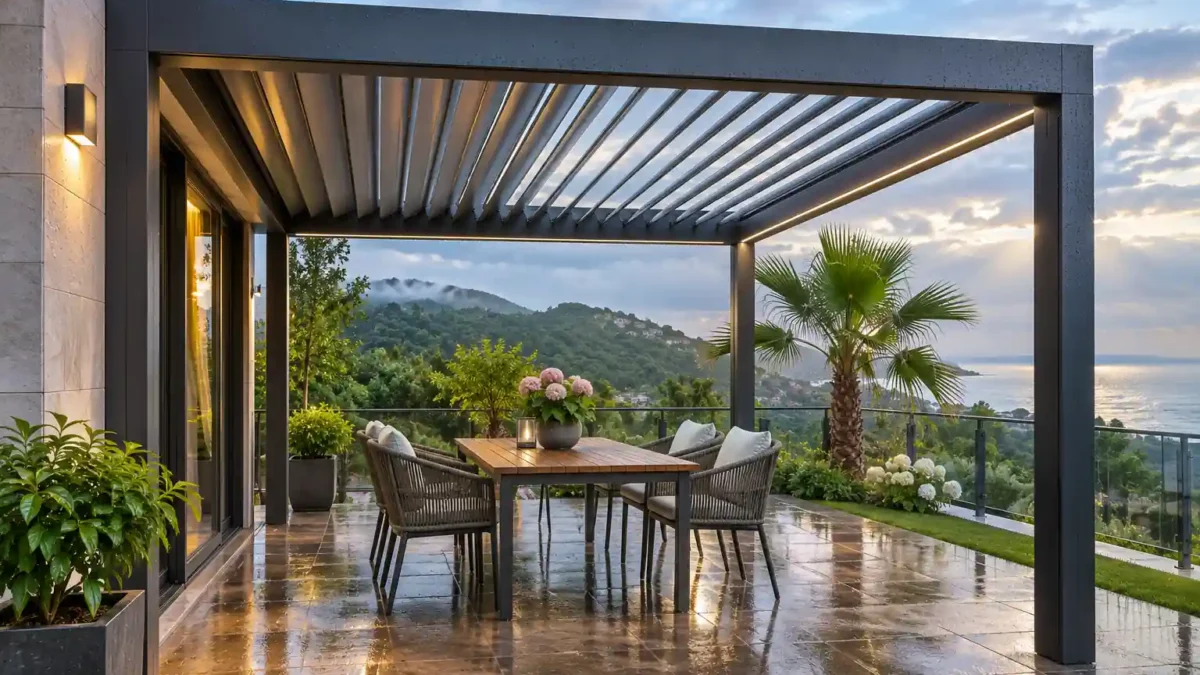
Then there are pergolas with rotating louvres. The louvres open when you want air and light and close in the rain, and the water runs away through gutters built into the posts. For a terrace in Batumi this is probably the most convenient format: shade with a breeze in summer, a dry table outdoors in autumn. More on the pages about aluminium pergolas and aluminium canopies.
Steel and aluminium side by side
| Criterion | Steel | Aluminium |
|---|---|---|
| Corrosion by the sea | Needs hot-dip galvanising and powder coating, welds under control | Does not rust, but needs an anodised or coated profile |
| Long span without supports | Its strong point | Needs larger sections or extra posts |
| Weight and load on the facade | Heavier, more often stands on its own posts | Light, easy to fix to the house |
| Heavy roofing and snow | Suitable | Only by calculation |
| Upkeep | Inspection and touching up chips | Washing with fresh water, checking fasteners |
| Where it fits best | Parking, utility canopies, mountains | Terrace, entrance, house right by the water |
Canopy roofing
In a rainy climate the roofing matters as much as the frame. Solid polycarbonate is strong and clear and lets light through, but it is noisy in a downpour. Multiwall polycarbonate is lighter and cheaper and diffuses light well, but over time moisture and dirt get into the cells if the ends are not closed with a vented end profile. Profiled metal sheet is cheap and reliable, but it is dark under it and loud in the rain. Sandwich panels are almost silent and give proper shade, but they are heavier and call for a stronger frame. Toughened or laminated glass looks best of all, but needs a serious load-bearing system and regular cleaning.
Whatever the roofing, it needs a slope and proper drainage. A flat canopy over a terrace in Batumi works like a pool in winter: water stands, then runs over the edge onto the steps and under the threshold of the house. The gutter, downpipes and draining the water away from the foundation go into the design from the start. Adding them after the first downpour costs more and looks worse.
Wind, snow and fixing
By the sea a canopy works like a sail. Gusts from below try to lift the roof, so with a light canopy what matters is how the roofing is held to the frame and how the frame holds on to the ground. Posts go on concrete footings with cast-in plates. A pipe simply dug into the ground will not last long by the sea. When fixing to a facade, check what the anchor actually goes into: cast concrete, brick or a layer of insulation under the cladding. The last one holds nothing.
In mountainous Adjara and at resorts like Bakuriani and Gudauri snow is added to the list. There the canopy is designed for snow load, given a steep slope and fitted with roofing that snow slides off without breaking the gutters. A structure that stands perfectly well in Batumi can fold in the mountains after the first heavy snowfall.
Canopy or extension
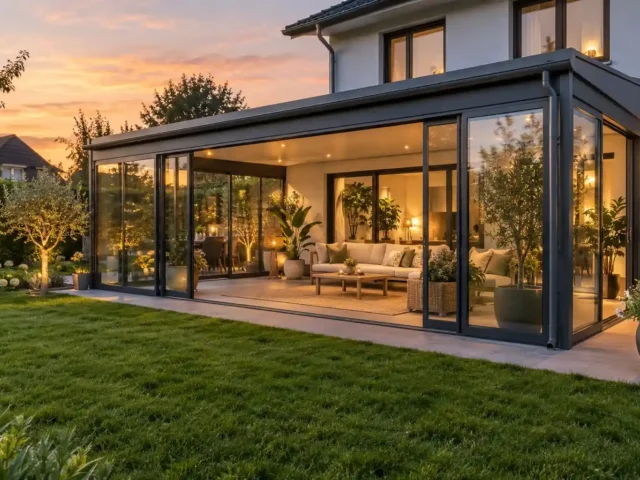
A common story: first a canopy goes up over the terrace, then the owners want to glaze it against the wind, then they add heating, and a year later it is a room. If you know in advance that this will happen, it is better to design an extension straight away. It has a different foundation, an insulated roof, drainage, a leak-free junction with the house and glazing that withstands the wind off the sea. Converting a light canopy into a heated room is almost always more expensive than building it that way from the start.
We build the glazed options on aluminium systems: aluminium extensions suit a winter garden, a covered terrace or a café shopfront. For a permanent extension in other materials there is extension construction. If the extension changes the floor area of the house or the facade of an apartment building, check the approval requirements with the city hall and your neighbours in the building beforehand.
Upkeep by the sea
Metal on the coast needs simple but regular care. Once a season, rinse the frame with fresh water, especially the places the rain does not reach: inner corners, the bottoms of posts, fixing points. Inspect the coating. A chip on a steel post touched up at once will not turn into a rust spot. Check the fasteners and bolt tightness after the winter storms. Clear leaves from the gutters before the rainy season.
If the house stands empty for half the year, this inspection is easy to include in looking after the whole plot. We do it as part of garden and grounds care, and terrace furniture that does not mind humidity and sun we make separately: terrace furniture.
Questions and answers
Do I need a permit for a canopy at a private house?
It depends on the size, the purpose and whether the canopy changes the volume of the building. A light canopy on your own plot is usually simpler than a permanent extension. The rules change from time to time, so before building check the requirements with the city hall of your municipality. If the structure is fixed to the facade of an apartment building, you will need the owners’ consent.
Which polycarbonate should I choose for a terrace?
For a terrace where light and strength matter, solid polycarbonate with UV protection is better. Multiwall suits utility canopies and carports, but the ends must be closed with a profile, or the cells will fill with water and green growth.
Can a canopy be installed in winter?
Yes. The frame and post footings go in on dry days, and rainy weather even helps you see straight away how the drainage works. There is one limitation: concrete for the footings is poured with care in hard frost, and in the mountains this is planned in advance.
What should I choose for a house that stands empty in winter?
An aluminium structure, anodised or powder coated, with closing louvres or solid roofing. It will get through the off-season unattended, and in spring a rinse is all it needs.
If you want to know what will suit your plot, start with the metal structures section: all types of canopies, pergolas and extensions are there. Send us a photo of the spot and rough dimensions, and we will tell you which structure and roofing will work.