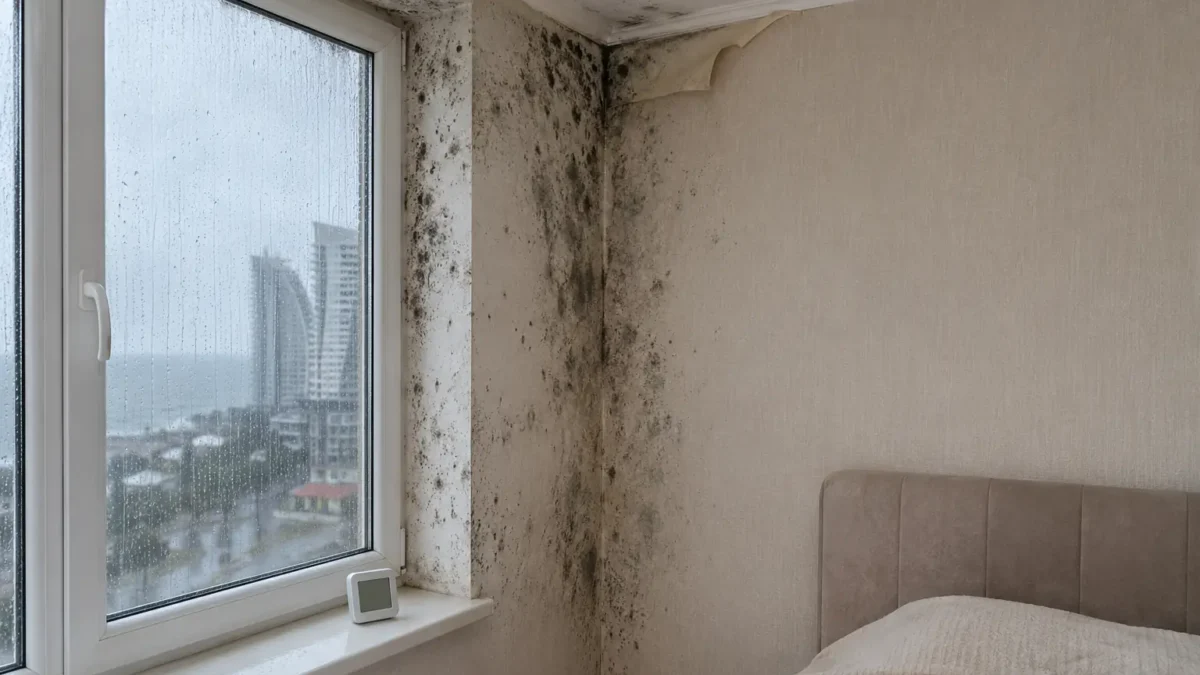
Black dots in the corner behind the wardrobe, wallpaper peeling away by the window, a musty smell from clothes after winter. Owners of flats in Batumi know the picture well, and most of the time a “bad building” is not to blame. The city sits on the sea, it rains a lot, especially in autumn and winter, and in summer the air is heavy and humid. A flat that has been locked up for a few months becomes the best place in town for mould. Below we go through where the damp comes from, how to find its source in one evening and what to do so that the mould does not return a month after the repairs.
In short
- Mould always follows water. Until the source of moisture is found, any treatment of the walls lasts a few weeks.
- There are usually four sources: condensation, a leak from outside, construction moisture in a new building and ground water on lower floors and in private houses.
- You can tell condensation from a leak within a day using a piece of film and some tape, with no instruments.
- Painting over the stains is pointless. The affected layers come off down to sound substrate, then the wall is dried, treated and only after that finished.
- An empty flat with no airing or dehumidifying almost always gets damp in winter, even in a good building.
Why it happens more often in Batumi
Batumi is one of the rainiest cities in the region. Most of the rain falls in the cold half of the year, when windows are shut and in many flats the heating only goes on when the owners arrive. Warm humid air settles on cold surfaces: external walls, corners, window reveals, glass. The rest is simple. A damp wall, a little dust to feed on, still air behind the furniture, and in a couple of weeks the first spots appear.
The second local factor is how homes are used here. Many flats are bought to let or for holidays, and nobody lives in them from October to May. The flat is not aired or heated, the water in the traps dries out and a sewer smell joins the damp. The third factor concerns new buildings. A cast concrete frame and screed release moisture for a long time, and in the first years after handover there is far more of it in the walls than it feels like to the touch.
Where the water comes from
Before buying anti-mould products, work out which of the four cases you have. Everything else depends on it, including who pays for the repair: you, the neighbour upstairs or the developer.
| What you see | Most likely | What to check |
|---|---|---|
| Spots in the corners of external walls, behind wardrobes, near the floor, drops on the glass in the morning | Condensation | Humidity in the room, the extract ventilation, the gap between furniture and wall |
| A wet patch with a clear edge that grows after a downpour | A leak from outside: facade, joint, balcony, roof | The link with rain and wind, the state of joints and sills outside |
| A patch on the ceiling or upper part of a wall that does not depend on the weather | The neighbour upstairs or a riser pipe | The bathroom and kitchen above you, shared pipes in the shaft |
| Damp throughout the flat in the first year or two after the building is handed over | Construction moisture | A hygrometer in different rooms, condensation on the new windows |
| Damp at the bottom of walls on the ground floor or in a private house | Ground water, no waterproofing on the foundation | The paving around the house, gutters and downpipes, the ground level by the wall |
Sometimes it is a mix. For example, a facade joint leaks, the wall gets wet and colder, and more condensation settles on the cold wall. So once you have found and fixed one cause, check again a month later just in case.
How to find the cause in a day
There is a simple way to tell condensation from water coming out of the wall itself. Take a piece of thick cling film or foil about 30 by 30 centimetres and tape it tightly to the damp spot with masking tape all the way round. After a day, better two, peel it off and look.
- Drops on the outer side of the film, facing the room: moisture from the air, so condensation. It is cured with ventilation, heating and dehumidifying.
- Moisture on the inner side, under the film: water is coming from the wall itself. Look for a leak or drying concrete.
- Wet on both sides: both causes are at work.
The second helper costs less than a trip to a café. It is a household hygrometer. Comfortable relative humidity at home sits roughly between 40 and 60 %. If in winter the bedroom reading stays at 70 % or more, mould will almost certainly appear, however often you wash the walls. For an accurate picture specialists use a thermal camera and a moisture meter: they show cold zones and wet areas that the eye cannot see.
Condensation and ventilation
Condensation forms when humid air has nowhere to go. The most common case in new buildings looks like this: PVC windows shut tight, no trickle vents, the bathroom and kitchen extract drawing weakly or blocked with building debris. Add laundry drying in the room and a hot shower, and the flat turns into a steam room.
What helps in practice:
- Check the extract. Hold a strip of paper to the grille. If it does not stick, the duct is not working, and a fan in the bathroom is no luxury here.
- Let air in. A trickle vent in the wall or the window frame, or the micro-ventilation setting on the window hardware.
- Move furniture at least 5 to 7 centimetres away from external walls. A wardrobe pushed against a cold wall creates a pocket of still air behind it.
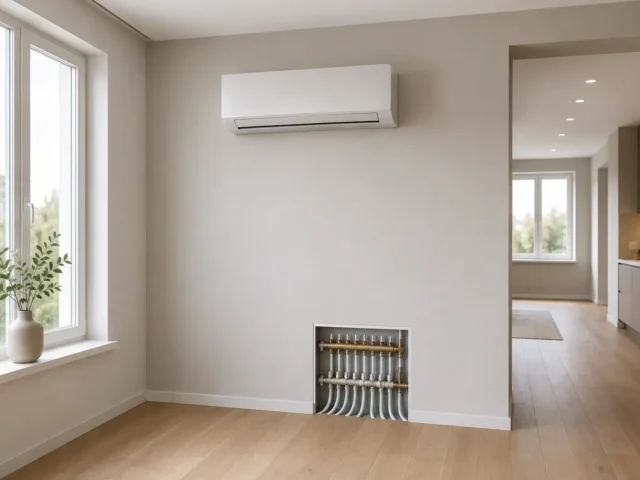
- Run the air conditioner in dry mode. Many split systems can work as a dehumidifier, and in the damp off-season this is often the easiest option. Just keep an eye on the drain and clean filters, or the mould will settle in the unit itself.
- Dry laundry on the balcony or in a dryer. A radiator in the bedroom is the worst place for it.
If the heating and air conditioning in the flat are poorly planned, we start with them. The walls can wait. We choose and install equipment for the specific layout as part of our heating and air conditioning work.
Windows, reveals and cold corners
In a Batumi flat the window is often the main spot for condensation. The causes repeat from building to building. The fitting foam was not covered with vapour barrier tape on the inside, and within a year it soaked up water. The reveals were plastered without insulation and are colder than the wall. The window board blocks the warm air rising from the radiator. With floor-to-ceiling glazing, condensation collects at the bottom profile and runs under the laminate.
Look at the window in the morning after a cold night. If only the edge of the glass is wet, that is normal physics for a double-glazed unit in a humid climate, and the cure is ventilation. If the reveals are wet, the corner of the frame is turning black or there is a draught from the joint, the problem is the installation. It is fixed by refitting the joint: vapour barrier inside, breathable tape outside, insulated reveals. More on how we redo these joints and glaze balconies on the windows and balconies page.
Corners of external walls on top floors and next to balcony slabs are a story of their own. Cold bridges run there, where the concrete of the floor slab comes out to the street. From inside such a corner can be several degrees colder than the rest of the wall. Insulation from inside with breathable materials helps, or better, insulation of the facade, but that is a decision for the whole building.
Leaks from outside
If the patch grows after rain with wind, the water is coming from the street. In Batumi rain often arrives at an angle, off the sea, and tests every joint. Typical places: the joint between facade panels or cladding, where the balcony slab meets the wall, a window sill without enough fall, a crack in the parapet, and on top floors the roof and gutters.
This kind of leak cannot be cured from inside the flat. You can replace the plaster as often as you like while water keeps getting into the joint outside. The usual order is this. Photograph the patch with the date, compare it with the weather and tell the homeowners’ association or the management company. If the building is new and under warranty, write to the developer. With a private house it is simpler: a survey of the facade and roof, repairs to joints, gutters and the paving around the walls. This work is part of our facade and roofing work.
How to remove mould so it does not come back
The most common mistake goes like this: wipe the spot, paint over it, hang new wallpaper. A couple of months later the spot shows through again, sometimes bigger than before. The mould does not live on the surface but deep in the filler and gypsum and under the wallpaper. The order that works:
- Remove the source of moisture. Without this the other steps make no sense.
- Dry the wall. A heat gun or a dehumidifier, sometimes for several days. Dryness is checked with a moisture meter: plaster feels dry to the touch long before it actually is.
- Strip the affected layers: wallpaper, filler, loose plaster. Sometimes down to the concrete or brick. Work in a respirator and gloves and take the debris out straight away in heavy bags.
- Treat the substrate with a deep-penetrating antiseptic following the manufacturer’s instructions, usually in two coats with drying in between.
- Level the wall with materials that let vapour through, such as cement or lime plasters. Dense compounds lock the moisture inside.
- Finish with breathable paint or wallpaper that does not form a film on the wall.
If more than a couple of square metres are affected or the mould is already in several rooms, it pays to do it in one go with replastering the walls instead of patching spots. We do this as part of our plastering work, and with serious damage we cost a full apartment renovation.
If the flat stands empty in winter
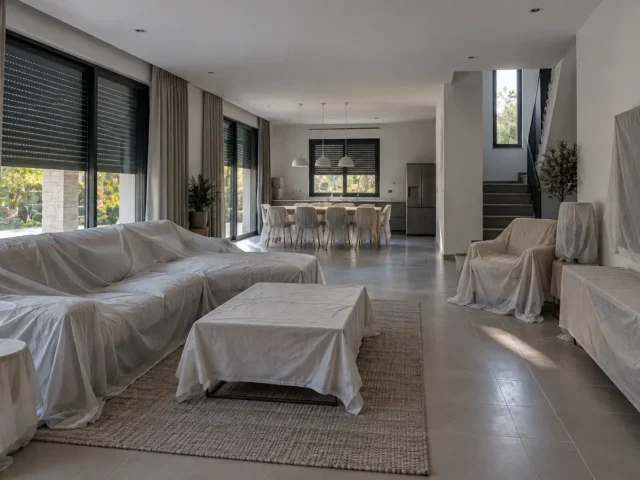
A flat that is let or kept for summer holidays almost always gets damp in winter, even in a good building. In a closed room with no heat and no air movement the moisture simply has nowhere to go. Before you leave, it is worth doing a few things:
- Leave interior doors and wardrobe doors ajar and move furniture away from external walls.
- Put textiles, cushions and mattresses into covers, ideally with moisture absorbers.
- Set up a dehumidifier that drains straight into the sewer so it does not switch off when the tank is full. Or arrange for someone to come and air the flat.
- Top up the traps with water or close the drains so there is no smell.
- Turn off the water at the inlet and photograph the meter readings.
If you are away for a long time, it is easier to leave the flat in someone’s care. We close it up for the off-season by a checklist and then come on scheduled visits: we air it, check humidity, drains and windows and send photos. Details are on the off-season shutdown page. For flats that are let, this is part of the regular apartment management. How to get a home ready for the season we covered in the article on preparing a flat for nightly letting.
Common mistakes
- Treating the wall with bleach and calling it done. Bleach removes the colour of the spot, but the mould stays in porous plaster.
- Covering a damp wall with plasterboard. A dark wet pocket forms behind it, and you will find out about it by the smell.
- Putting in a powerful heater and closing the windows. Warm air holds more moisture, and without airing it will settle wherever it is colder.
- Finishing a new-build flat straight after handover with dense materials and no drying time. The construction moisture then comes out through the finish.
- Looking for the cause inside when the patch only appears after a downpour. In that case the facade is leaking, and the plaster in the flat has nothing to do with it.
Questions and answers
Is mould in a flat dangerous?
For many people, yes. Mould spores irritate the airways and can make allergies and asthma worse, which is why the WHO guidelines on indoor air quality single out damp and mould as a risk factor. Do not put off dealing with mould in a child’s room or a bedroom.
What humidity should a flat have?
Aim for 40 to 60 %. In a Batumi winter without dehumidifying and airing it easily goes above 70 %, and that is the zone where mould grows fast.
Is the air conditioner enough, or do I need a dehumidifier?
For a lived-in flat the dry mode on the air conditioner plus a working extract is often enough. For a flat that stands empty in winter a separate dehumidifier draining into the sewer is more convenient: it runs unattended and a full tank does not stop it.
How long does a new building take to dry out?
Usually the first one or two heating seasons. During that time keep the finishes breathable, air the flat more often and do not push furniture against external walls.
Who pays if the facade is leaking?
It depends on whose responsibility it is. The shared facade and roof belong to the building as a whole. In a new building under warranty, write to the developer first. If the patch appeared after the neighbour upstairs did their renovation, the question goes to them. Dated photos will be useful either way.
If the damp came back after a renovation or you cannot find its source, request an inspection. We will find where the water is coming from and suggest the order of work. When another crew is doing the renovation, site supervision will help you keep it in check.