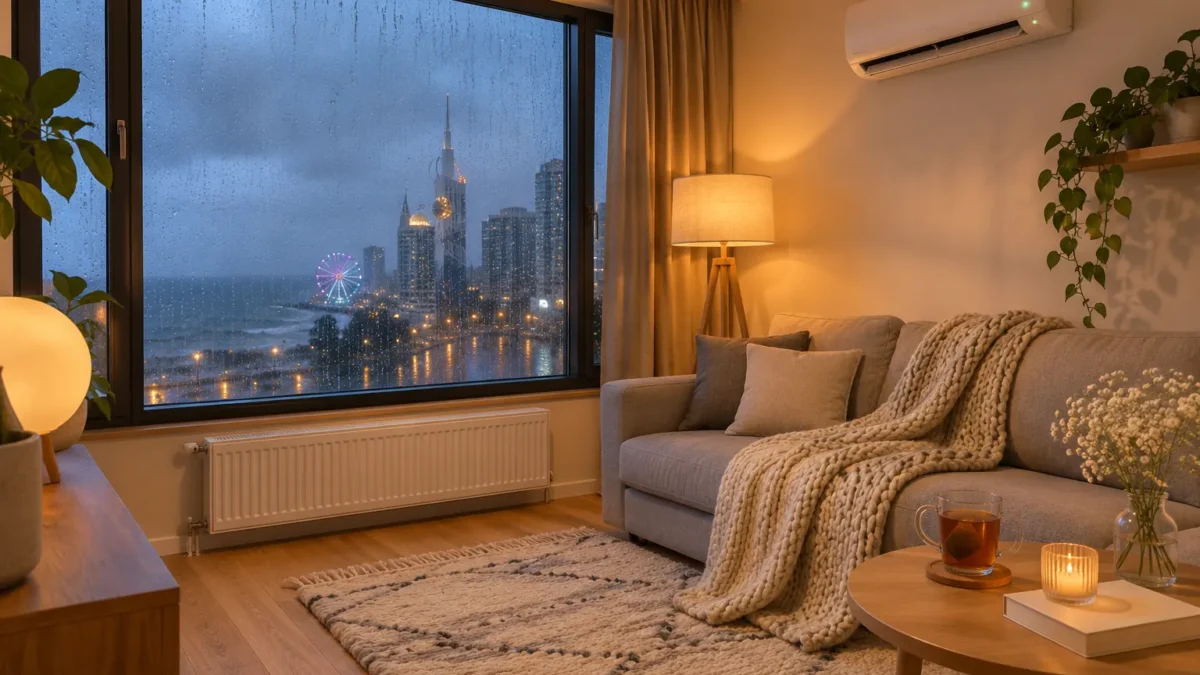
Winter in Batumi is mild: snow falls once every few years, and daytime temperatures outside are usually between +5 and +12 °C. That does not make the flat any warmer, though. There is no central heating here in the usual sense: every flat heats itself, and in new builds the external walls are often uninsulated aerated concrete block with large windows. Add the humid air, which makes the cool feel sharper, and it becomes clear why heating a flat in Batumi worries owners as much as the renovation itself. We look at the options that genuinely work here: an air conditioner, a gas boiler with radiators, underfloor heating and electric heaters. We also cover what each one costs to run, what installation involves and which mistakes leave a flat cold even with good equipment.
In short
- In most flats in Batumi the main source of heat is an inverter air conditioner. In a mild winter it uses 3–4 times less electricity than a heater of the same output.
- A gas boiler with radiators gives the most even heat, but it needs gas in the flat, a flue and a design approved by the gas company. Not every new build has a gas supply.
- Water-based underfloor heating is comfortable, but it takes up 7–10 cm of floor height and needs a screed. Electric underfloor heating makes sense in the bathroom and kitchen, not as the only source of heat.
- Convector heaters and oil-filled radiators are fine as a backup. Running constantly, they quickly push the electricity bill into the most expensive tariff band.
- A large share of the heat escapes through windows, reveals and cold corners. Deal with the losses first, then choose the output.
What winter is like in a Batumi flat
A flat in Batumi needs heating from roughly the end of November to the end of March, and into April in a cool year. Hard frosts are almost unheard of, but there are weeks of rain with wind off the sea, and the sun rarely shows itself in December. Batumi is one of the rainiest cities in Georgia, and humidity stays high in winter even inside the flat.
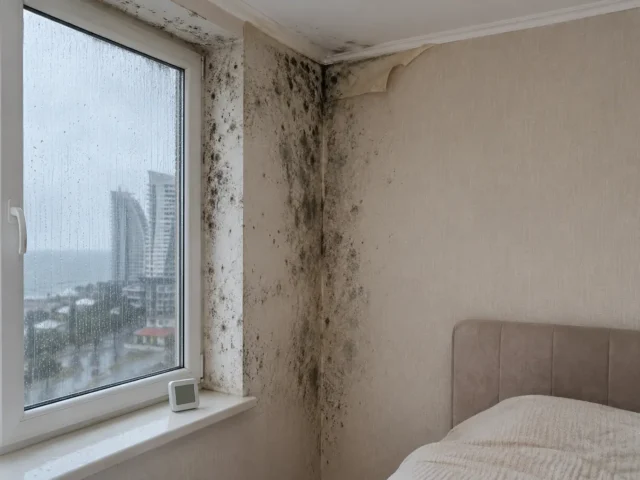
How cold it gets indoors depends above all on the building. A reinforced concrete frame with aerated block infill holds heat reasonably well if the facade is insulated. Without insulation, the concrete columns and slab edges are exposed directly to the outside and become cold bridges: condensation forms in the corners next to them, followed by mould. Panoramic glazing in aluminium frames without a thermal break acts in winter like a large radiator working in reverse. Corner flats and top-floor flats lose noticeably more heat than a flat in the middle of the building with south-facing windows.
That is why the same air conditioner gives completely different results in two neighbouring buildings. Before choosing a system, take an honest look at the flat: the floor, which way it faces, the window area and whether the facade is insulated.
An air conditioner as the main heating
In heating mode an air conditioner works as a heat pump: it takes heat from the outdoor air and moves it into the room. With +5 to +10 °C outside this is very efficient. A good inverter air conditioner delivers 3–4 kWh of heat for every 1 kWh of electricity, while an oil-filled radiator gives out exactly as much as it consumes. For Batumi’s mild winter this is the main argument, and it is precisely why almost every flat by the sea has an air conditioner.
What to look for if the air conditioner is going to heat, not just cool:
- Inverter. An inverter compressor does not switch on and off in jolts; it varies its output smoothly. The temperature stays more even, consumption is lower and there is less noise.
- Heating capacity. The specifications list cooling and heating output separately. For heating, the second figure is the one that matters, and it varies from model to model.
- Protection against sea air. Salt eats away at the aluminium fins of the outdoor unit. Models with an anti-corrosion coating on the heat exchanger last longer by the sea.
- Wi‑Fi control. It is handier to switch the heating on an hour before you arrive, or to check the temperature in an empty flat, from your phone.
An air conditioner has its weak points too. Warm air rises to the ceiling and the floor stays cool, especially if it is tiled. It heats the room it is mounted in: if the doors are closed, a bedroom without its own unit will be cold. In heating mode the air dries out a little, and in Batumi that is more of an advantage: relative humidity in the room falls and the damp recedes.
There is an important detail that people usually remember only after installation. In winter the outdoor unit periodically defrosts and sheds water. If the drain is not routed away, the water drips onto a neighbour’s balcony or down the facade. This is worth planning for from the start.
For two or three rooms, you either fit a separate unit in each room or install a multi-split system with one outdoor unit. If the flat is getting a suspended ceiling, a ducted air conditioner is an option: the unit is hidden above the ceiling and air is distributed to every room through grilles. We handle selection, refrigerant lines and installation as part of our heating and air conditioning service.
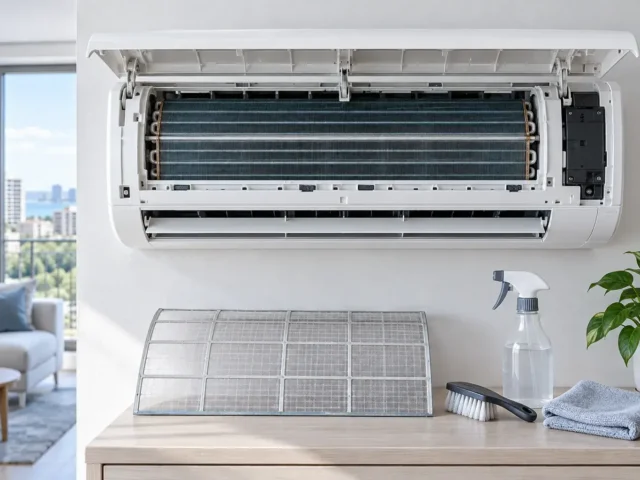
An air conditioner that heats all winter needs regular servicing. During the season the filters are washed every two to four weeks, and once a year the heat exchangers are cleaned and the drain is checked. By the sea this is especially important, otherwise the output drops noticeably after a couple of seasons. Our air conditioner servicing team takes care of this.
Gas boiler and radiators
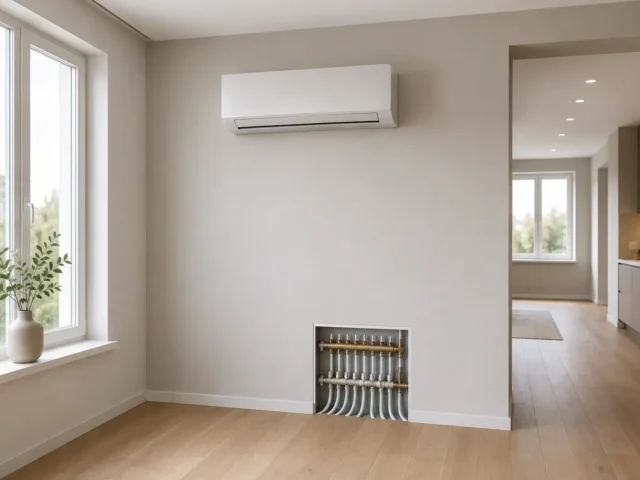
If gas is supplied to the flat, you can install a conventional wet heating system: a combi boiler heats both the water for the radiators and the hot water for the kitchen and bathroom. Radiator heat is the most even and familiar kind: the walls are warmed through, there is no blown air, and the floor is not as cold as with an air conditioner alone.
The first thing to find out is whether there is gas at all. In some new builds, especially high-rises, gas is not brought into the flats, and then the choice immediately narrows to electricity. It is best to check this before buying, or at least before the renovation is designed, because the whole layout of the system depends on it.
What a boiler requires:
- A design and connection through the gas company. You cannot move a gas pipe or install a boiler yourself.
- A flue. In flats the usual choice is a boiler with a sealed combustion chamber and a coaxial flue through the wall. Whether the flue may exit through the facade depends on the building’s design and the management company’s rules, so check this in advance.
- A place for the boiler with access for servicing: the kitchen, the bathroom or a utility niche.
- Pipes to the radiators, laid in the screed or in the walls. This means the decision on a boiler is made at the rough works stage, not after the finishing.
Radiators go under the windows: the rising warm air cuts off the cold coming from the glass, and there is less condensation on the reveals. A condensing boiler costs a little more than a standard one but uses gas more efficiently. Like an air conditioner, a boiler needs servicing once a year.
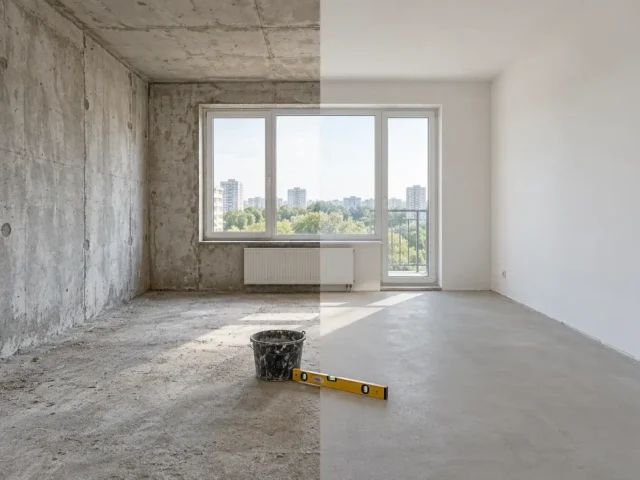
If you bought the flat in black or white frame, it is easiest to plan the heating system in from the start, together with the electrics and plumbing. We explained how these two conditions differ and in what order to carry out the work in our article on black frame and white frame.
Underfloor heating: water-based and electric
People love underfloor heating for its comfort: the heat comes from below, the floor feels pleasant underfoot even when it is porcelain tile, and the air under the ceiling does not overheat. In a flat, though, it has its limitations.
Water-based underfloor heating runs off a gas boiler. The pipes are laid on a layer of insulation and covered with screed, which adds up to 7–10 cm of floor height. In a flat with a 2.7 m ceiling that is noticeable, and you also have to think about thresholds and the floor level on the balcony. Water-based underfloor heating warms up slowly and cools down slowly, so it suits a flat where people live permanently and is a poor fit for short-stay letting, where the flat has to be warmed quickly before guests arrive. If there is a car park or a cold technical floor below the flat, half the heat will escape downwards unless there is insulation under the pipes.
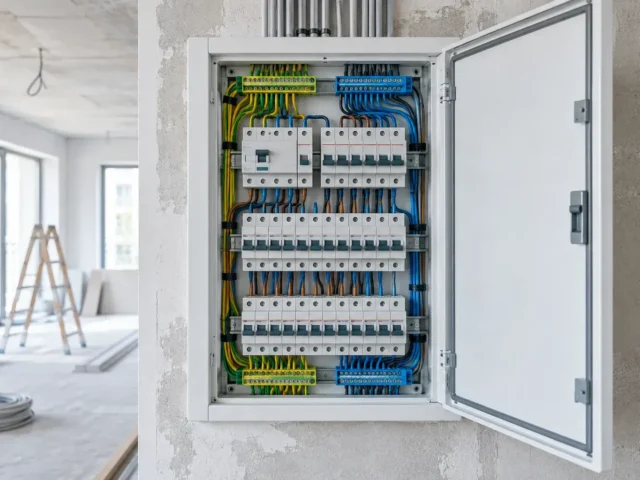
Electric underfloor heating comes in two kinds: cable (a cable or heating mat laid in tile adhesive or a thin screed) and film (under laminate or vinyl). It is fitted where comfort matters most: the bathroom, kitchen and hallway. You can heat the whole flat with it, but the running costs are roughly the same as with heaters, only the heat is spread more pleasantly. A thermostat with a floor sensor and a dedicated circuit with an RCD are essential, especially in the bathroom. The wiring for it is laid during the electrical works, and the screed is made with the thickness of the system in mind. There is more about screed on the plastering and screed page.
The floor covering matters too. Ceramic and porcelain tiles conduct heat best. Laminate and vinyl are suitable if the packaging says they are compatible with underfloor heating. Solid wood boards are rarely laid over underfloor heating, and then only with temperature limits.
Convectors and oil-filled radiators
Electric convector heaters, oil-filled radiators and infrared panels are inexpensive and take a minute to set up. But they convert electricity into heat one to one. Over the same winter they use three to four times as much electricity as an air conditioner.
The tariff matters here as well. For households in Georgia it is tiered: the more kilowatt-hours you use in a month, the more each additional one costs. While a heater is switched on for an hour or two, this goes unnoticed. When it runs around the clock, consumption moves into the top band, and the bill rises by more than a simple calculation would suggest. On top of that, household electricity tariffs were raised in spring 2026.
There is a technical side too. Every flat has a limited allocated power capacity, and two or three heaters running alongside a water heater, kettle and oven can easily trip the breaker. Extension leads and old wiring heat up under that kind of load. So it makes sense to keep heaters as a backup: to warm the bathroom in the morning, dry out a room or cover the gap while the air conditioner is being repaired.
Comparing heating options
| Method | Cost of heat | Comfort | What installation requires | Who it suits |
|---|---|---|---|---|
| Inverter air conditioner | Low: 3–4 kWh of heat per 1 kWh | Heats up quickly, floor stays cool, noticeable airflow | Refrigerant lines, space for the outdoor unit, drain, dedicated circuit | Almost everyone, especially rental flats |
| Gas boiler and radiators | Low, comparable with an air conditioner | Even heat, hot water included | Gas in the flat, design, flue, pipes laid at the rough works stage | People who live in the flat permanently |
| Water-based underfloor heating | Low when run from a boiler | The most pleasant, but slow | Boiler, insulation, 7–10 cm screed | Permanent residence, high ceilings |
| Electric underfloor heating | High | A warm floor where you need it | Dedicated circuit, RCD, thermostat | Bathroom, kitchen, hallway |
| Convectors and oil-filled radiators | High, plus the top tariff band | Local heat | A socket and spare capacity | Backup and temporary heating |
How much heating a flat in Batumi costs over the winter
Only your first winter will give you an exact figure, but you can estimate the order of magnitude in advance. Take a 55–60 m² flat on a middle floor with ordinary windows, where the living rooms are kept at +20 to +21 °C. Over the heating season a flat like this needs roughly 3,000–4,500 kWh of heat. Everything then depends on how you produce that heat.
- An air conditioner with a real-world coefficient of performance of about 3 will use 1,000–1,500 kWh of electricity for this over the season, which is roughly 200–330 kWh a month on top of your normal consumption.
- Heaters will use the full 3,000–4,500 kWh, which means an extra 650–1,000 kWh a month. Almost all of it will fall into the expensive tariff band.
- A gas boiler gets about 9 kWh of heat from a cubic metre of gas, allowing for losses, so the season will take roughly 330–500 m³.
Multiply these amounts by the current tariffs on your own bill, and you will see which system works out cheaper in your case. Electricity and gas tariffs in Georgia are regulated by the state and revised from time to time, so do not base your calculations on last year’s figures.
A few adjustments to the estimate. A corner flat, a top floor or panoramic glazing adds 30–50% to the heat demand. Each degree lower in the room saves roughly 5–6%. A night setting of +18 °C in the bedroom, and +16 °C when nobody is at home, noticeably lowers the bill without any loss of comfort.
Where the heat goes
Before buying more powerful equipment, it is worth closing off the losses. That is often cheaper, and the effect is more noticeable.
- Windows and balcony doors. The hardware on uPVC windows is switched to winter mode so that the sash presses more tightly against the seal. Worn seals are replaced. Gaps under the window board and uninsulated reveals cause cold strips and condensation. This can be fixed in a day, and there are more details on the windows and balconies page.
- Panoramic glazing. Heavy floor-length curtains and a radiator or convector by the glass cut off the cold draught that flows down the glass onto the floor.
- Cold corners. Columns and slab edges that reach the facade stay colder than the walls. Avoid placing furniture tight against such corners: air does not circulate behind it, and that is where mould appears first.
- Front door. If the building’s corridor is unheated, cold air comes in through the gaps around the door. A door seal and an automatic drop-down threshold help.
- Ventilation. You should not seal the flat up completely, or the humidity will rise. A compact supply and extract unit with heat recovery brings in fresh air and returns most of the heat from the outgoing air to the room, while also lowering humidity.
If the flat stands empty in winter
Many owners live in Batumi in the summer, and in winter the flat stays locked up. Switching the heating off completely for the whole winter is risky: walls and furniture get damp, and with high humidity mould starts to grow in a closed flat. We wrote in detail about why this happens and how to deal with it in our article on damp and mould in a flat.
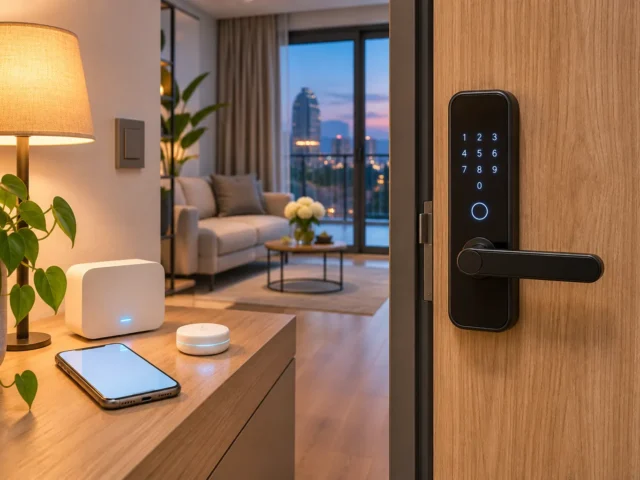
A sensible setting for an empty flat is +10 to +12 °C with humidity no higher than 60%. Many air conditioners have a standby heating mode that holds +8 to +10 °C; it uses little power and protects against damp. Temperature and humidity sensors with phone notifications show what is happening in the flat, and leak sensors with a shut-off valve will turn off the water if something goes wrong. All of this can be linked into one system, and there is more on the smart home page. If there is nobody to look in on the flat, our property upkeep service takes over scheduled checks and airing.
Common mistakes
- Choosing an air conditioner by price and cooling capacity without looking at its heating capacity and corrosion protection.
- Mounting the indoor unit so that it blows straight at the bed or into a wall rather than into the room.
- Not routing away the drain from the outdoor unit, which sheds meltwater in winter.
- Deciding on heating after the finishing, when there is nowhere left to hide the pipes and cables.
- Laying water-based underfloor heating without insulation above a car park or a cold floor.
- Plugging several heaters into one socket through an extension lead.
- Buying more powerful equipment instead of adjusting the windows and sealing the gaps.
Questions and answers
Will one air conditioner be enough for the whole flat?
For a studio or an open-plan flat it usually is. If there are separate bedrooms, you need a unit in each room, a multi-split or a ducted system. One powerful air conditioner in the living room will not heat a bedroom behind a closed door.
Which is cheaper to run: gas or an air conditioner?
In terms of the cost of heat they are close, and the difference depends on current tariffs. Gas gives more even heat and hot water, while an air conditioner is cheaper to install and needs neither gas nor a flue. For rental flats, air conditioners are the more common choice. For permanent living, people increasingly combine a boiler with air conditioners.
Can a gas boiler be installed in any flat?
No. You need gas supplied to the flat and a way to route a flue that fits the building’s design. The installation is designed and connected by the gas company. Before the renovation, check this with the building’s management company.
What temperature should I keep if I am away for the winter?
Around +10 to +12 °C, with humidity no higher than 60%. That is enough to stop the finishes and furniture from getting damp, while consumption stays low.
At what stage of the renovation should heating be decided?
Before the rough works, together with the electrical and plumbing design. Air conditioner lines, radiator pipes, underfloor heating cable and dedicated circuits are all laid before plastering and screeding.
If you are planning a renovation and want the flat to be warm in winter without huge bills, start with an inspection of the flat and a heating layout. We select and install systems in Batumi and across Adjara: see our heating and air conditioning section, and if the whole flat needs renovating, take a look at apartment renovation.